Count reduction and transformed signals
A forward/backward asymmetry compares two groups of acquired positron counts. The counts must describe corresponding observations before their ratio has a physical interpretation. Asymmetry therefore prepares counts and their uncertainty information together, keeping timing, grouping, correction settings, and the selected interval with the result.
An explicitly selected ordinary double-pulse time response acts on the fitted prediction after reduction. It changes neither acquired counts nor this ratio/error pipeline. Ordinary fits keep point predictions at retained times rather than integrating source counts over an arrival-straddling bin.
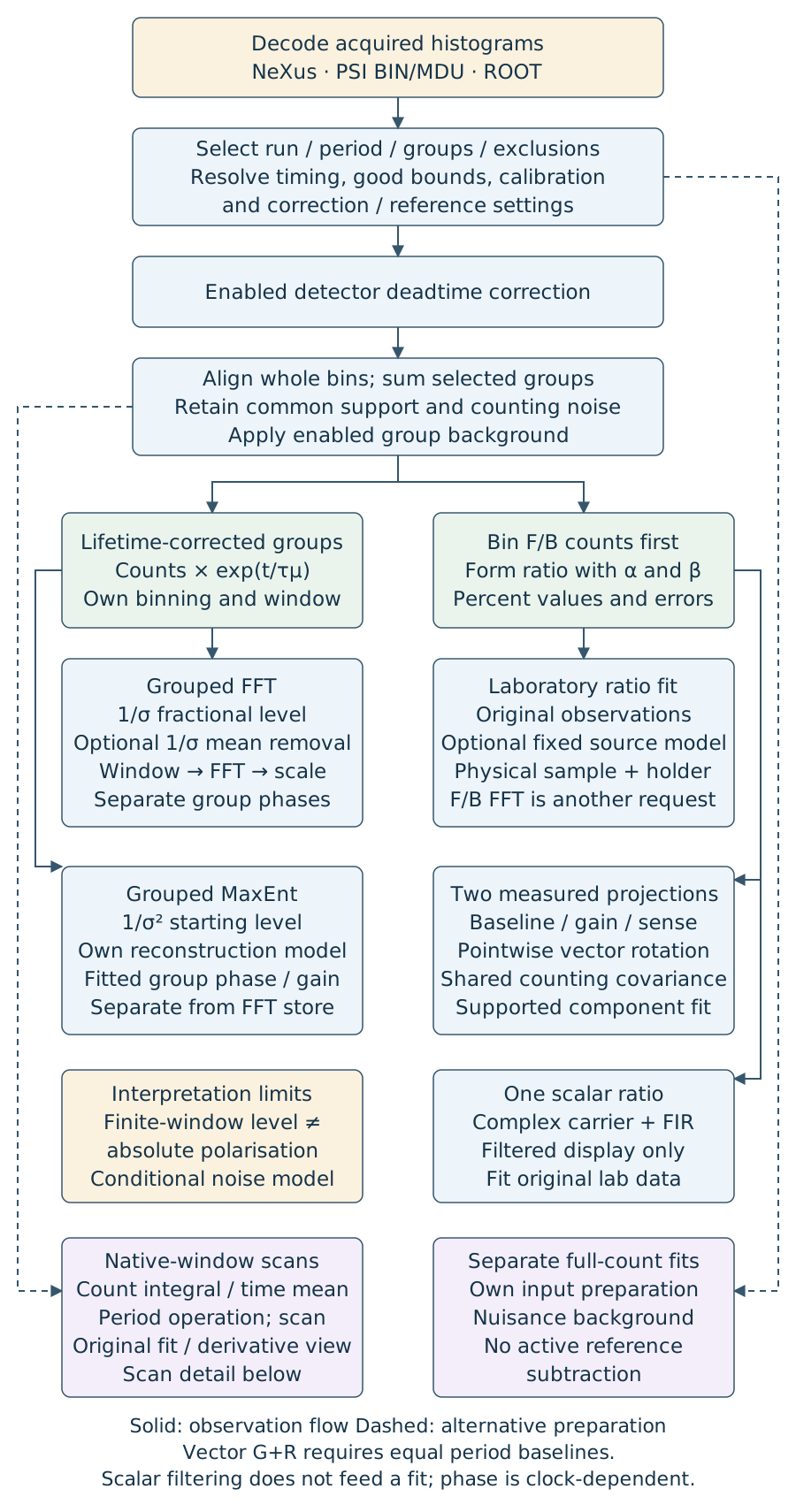
The observation determines the analysis branch. Solid arrows carry selected observations and retained uncertainty information; dashed lines identify alternative requests with their own preparation. Corrections act only when enabled. Grouped fits and integral observables retain their separate input contracts. A filtered scalar display does not feed a fit. The condition-scan detail expands the native-window scan branch. On narrow screens the figure can be scrolled horizontally.
Run co-add/subtraction retains original acquisitions behind its raw inspection view. Each required original detector enters correction and whole-bin alignment with its own facts before signed weighting and pooling on common observed good support. Counts use the coefficient and independent variance its square. The requested group background or shared reference is applied once after pooling. See Run arithmetic: co-add and co-subtract for exposure and count-model limits.
Effective reduction recipes
Count-backed asymmetry, native count-integral/time-bin-mean results, and condition scans carry a captured effective recipe. It records the actual detector membership and exclusions, acquired constituents and signed coefficients, resolved timing and good support, whole-bin alignment and residuals, applied alpha/beta and available calibration records, correction outcomes, reference source/timing/scale, binning, observable, units, and conditional uncertainty assumptions. Counting uncertainty from estimated range/tail backgrounds remains propagated; applied calibration, fixed correction coefficients, and reference scale remain conditional. The record is independent of later edits to the source run or grouping.
Time crops retain their selected bin membership. Counts-first merges retain staged selections and their actual aligned-bin edges; curve means record averaging instead. Two-projection rotation records both inputs and the supplied frame. Native scalar reductions distinguish a ratio of summed counts from a mean of native ratios; scan selection and forward differences retain their operation and display-only derivative restriction. These records do not add covariance or likelihood capabilities. Run-ordered workflow scans retain source-run coordinates in the scan recipe; the point recipes retain the acquired period selectors.
The small recipe is separate from the transient histogram replay snapshot. A
historical curve without captured provenance keeps an unknown recipe; a transform
of unknown inputs records those inputs as unknown. A recipe alone cannot recreate
raw counts, prove the identity of an acquisition file, or establish that a saved
result is compatible with current computation. Work-directory and scan codecs
retain captured recipes; projects retain result and fitted-input history without
restoring raw replay from that history. Publishable recipe fields omit nested local
locators and diagnostic prose. The uncorrected
TimeFBAsymmetry representation records its actual fractional ratio without
applying grouping correction switches. Its held-period or combined inspection
inputs remain unsupported recipe cases because that raw operation does not
consume original constituent preparations. Group-only signals, Fourier spectra, MaxEnt
reconstructions, and unsupported transformed curves have no complete effective
reduction recipe; their operation-specific provenance retains its own contract.
Compared with other programs
musrfit 1.12.1 declares sources, grouping, timing, packing, and calibration in its explicit analysis configuration; see its user manual. Mantid records applied algorithms and properties in workspace history and can generate a Python script. That operation record is distinct from saved processed data and from the availability of external inputs needed for replay. WiMDA 1.326 annotates reduced exports with grouping and correction settings; its overview and manual describe the broader workflow. These are configuration and annotation comparisons, without a claim of numerical equivalence or identical identity guarantees. The Mantid comparison uses its public history documentation, without a matched native execution.
Asymmetry also checks that its captured recipe has a stable canonical numerical identity. Dictionary order, local source paths, and display labels do not affect that identity; recorded acquisition references and effective numerical facts do. Unknown acquisition content identity remains unknown.
Branches after count preparation
The diagram is a map of alternative observables, not a mandatory sequence through every transform. The same post-decoding scientific operations apply to ISIS HDF4/HDF5 and PSI BIN/MDU/ROOT when the selected observations and settings match. Source structure, measured timing, and geometry can guide settings; facility labels guide defaults, and a file suffix does not determine physics.
Lifetime-corrected group signals multiply prepared group counts and errors by \(\exp(t/\tau_\mu)\). Grouped FFT and MaxEnt each request uncentred signals, then apply their own window-level preparation. FFT uses a \(1/\sigma\) fractional level and optional mean removal; MaxEnt uses an inverse-variance starting level and its own phase/amplitude reconstruction. Neither finite-window level nor FFT coherent-gain correction establishes an absolute polarisation calibration. See Fourier analysis for the selected-window, apodisation, padding, and endpoint limits.
F/B ratios combine prepared F/B counts with α and β. They can be fitted in the laboratory frame or transformed as described below. The Fourier panel’s F−B asymmetry source transforms a ratio rather than the default lifetime-corrected grouped signals; its correction contract is specified in Fourier analysis.
Two measured transverse projections support pointwise rotation after explicit baseline, gain, sense, and phase adjustment. Retained shared acquisition/reference/background counting noise propagates through the coordinate transformation and packing. Calibration and frame quantities remain conditional assumptions. A group label or fitted phase is not proof of physical detector geometry. See Assumptions and limitations and Counting observations and conditional errors for the authoritative geometry and covariance contracts; Rotating-frame projection also describes fitting a supported component.
One scalar ratio supports complex demodulation and FIR low-pass display. Same-bin real/imaginary covariance enters first-order magnitude errors, but filtered bins remain correlated, low-signal magnitude is biased, and a correlated or anisotropic noise pair need not obey an exact Rician law. Fits retain the original laboratory observations, rather than treating the filtered display as independent data. See Magnitude errors.
For pooled G+R vector rotation, Asymmetry requires the Red and Green transverse baselines to agree; an arithmetic mean is not generally the baseline of a pooled count ratio. Unequal baselines make that operation unavailable while Lab G+R, rotating Red, Green, and G−R remain supported. This safeguard does not restrict decoding or unrelated reductions.
Grouped fits use the full-count model and their own nuisance backgrounds; active reference-run subtraction is unsupported there, even though it is supported in grouped Fourier/MaxEnt preparation. Their lifetime-corrected Gaussian and raw-count Poisson objectives are separate choices. See What this mode fits and Count-domain fitting (α calibration & single histograms). Integral observables retain their own window, balance, and estimator rather than integrating a displayed FFT or filtered curve. All error statements remain conditional on the documented calibration and correction assumptions. Correct marginal errors do not supply a general cross-bin or joint-projection likelihood, or certify overlapping-group MaxEnt. The operation-specific reference map is in Normalisation and transformed observations.
From acquired counts to a ratio
Decode and select. NeXus, PSI BIN/MDU, and supported PSI ROOT readers preserve acquired histograms and resolve file timing and calibration facts. NeXus physical good times become per-detector, per-period raw-bin intervals at this boundary, before t0 subtraction; selection does not crop acquired arrays. Choose the run, period, projection, groups, and exclusions. Selection identifies observations; it does not add runs or periods together. A file suffix does not choose pulsed- or continuous-source physics. The format-specific contract is in Loading Data.
Prepare individual detectors. Resolve the effective timing and requested interval, and apply enabled deadtime correction to individual detector histograms using the applicable calibration and exposure. The aligned interval is resolved with the selected channels’ common support at the grouping step; file bounds and explicit windows are different inputs to that resolution. A selected reference acquisition resolves its own period, timing, detector preparation, and exposure. Automatic scale uses compatible evidenced exposure ratios, visibly assuming one when exposure is unknown; Manual scale uses the authored positive coefficient. Reference alignment requires compatible native widths and enough observed support; it does not interpolate or pad counts. See Detector Grouping and Layout for correction assumptions and failures.
Mapped sets resolve these detector preparations against their original acquired members, including their own coefficients, exposure, file-good bins, and t0. Only selected members enter timing and correction domains. Missing required File coefficients withhold correction from the entire requested result.
Align, sum, and subtract group backgrounds. Whole-bin shifts align the selected detectors without interpolation. The maximum selected integer anchor sets the reference, with acquired-channel ordinal breaking ties; its exact origin supplies the time stamps. Fractional residuals record the approximation, not a timing uncertainty. Only common observed support enters the group sums, including across constituents of a mapped set. Counts and retained variances pool before one ordinary background operation for that set. Enabled range, tail-fit, fixed, or reference-run backgrounds then act on those grouped counts, rather than independently on each raw detector. These are alternative background modes. Reference subtraction retains both independent counting variances with fixed scale; accidental levels and physical holder polarisation are different quantities. See Background correction.
Bin counts, then form asymmetry. The good window selects the observations
for analysis bins. Counts and the full retained variance model, including shared
background-estimate components, are combined before the F/B ratio is formed.
Nonuniform targets use the actual left edge and nearest whole-bin membership,
with half-up ties and at least one acquisition bin. Timestamps are actual
contributing-bin midpoints with exact-t0 residuals. Base nonuniform support
retains a partial tail; fixed packing and additional merges trim only incomplete
groups. Averaging already formed ratios is a different operation. For example, with
unity balances, no corrections, and independent Poisson counts, adjacent pairs
(F, B) = (9, 1) and (1, 1) merge to (10, 2), giving asymmetry 2/3 rather than
the mean ratio 0.4. The
reduce_grouped_asymmetry API reports asymmetry
and uncertainty in percent, and time in μs relative to the selected exact
origin. The lower-level binned_fb_asymmetry()
returns fractional asymmetry and uncertainty. See
Asymmetry units across the API for API scales and
Histogram binning for bin edges, partial bins, and errors.
Single/global fit-wizard automatic merges replay the actual histogram observation through these same numerical stages, preserving base and toolbar merges and selected output-bin membership. Curves without resolved replay context and rotated curves retain independent-curve means. Scores and rebuilt curves refer to the prepared observation; historical saved scores are not refitted on load. The internal wizard FFT diagnostic still requires uniform input sampling.
Each F/B consumer resolves alpha for its actual selected pair. Display binning, F/B Fourier input and re-reduction retain that projection’s coefficient while the authored base alpha remains available as the fallback for other pairs.
File-good limits stay on acquired raw bins through timing edits; selected-channel alignment maps them into the common observed interval. Manual window endpoints are signed offsets from effective t0, with omitted endpoints retaining mapped file limits. The resolved window also supplies finite-window calibration integrals. See File bounds and authored relative windows and Detector Grouping and Layout.
Fit physical signals. The asymmetry model can add sample and holder polarisation components with independent amplitudes and appropriate relaxation or precession. This stage describes physical muon populations; it does not subtract another accidental count level. Existing Composite models supply these components. Exposure scaling of an empty-holder run alone does not determine the holder contribution in the sample acquisition.
Calibration dependencies
Calibration is not a single serial transformation of the counts. File or chosen timing anchors control alignment; detector coefficients and exposure control deadtime correction; background estimates or a reference spectrum control subtraction. The balances α and β enter the asymmetry formula after count binning. A requested estimate can itself depend on prepared counts.
Fixed and one-shot calibrated values remain stored when grouping changes.
An enabled automatic policy instead uses its current inputs. In particular,
per_run_estimate α uses the current corrected, grouped counts and good
window; it does not repeat a diamagnetic fit. β has fixed and calibrated
policies, without an automatic integral-ratio policy. The owning contracts are
Alpha calibration,
Beta calibration, and
Grouping and calibration walkthrough.
Other observables and observation models
Condition-scan observables
The native-count preparation supplies Integral scan mode (avoided-level-crossing field scans), including enabled constant or reference-run background and retained shared counting responses. Select whole native bins by inclusive time centres, using the good window when bounds are omitted. Display bunching does not change this support. The scan detail below separates count integrals from explicit time means.
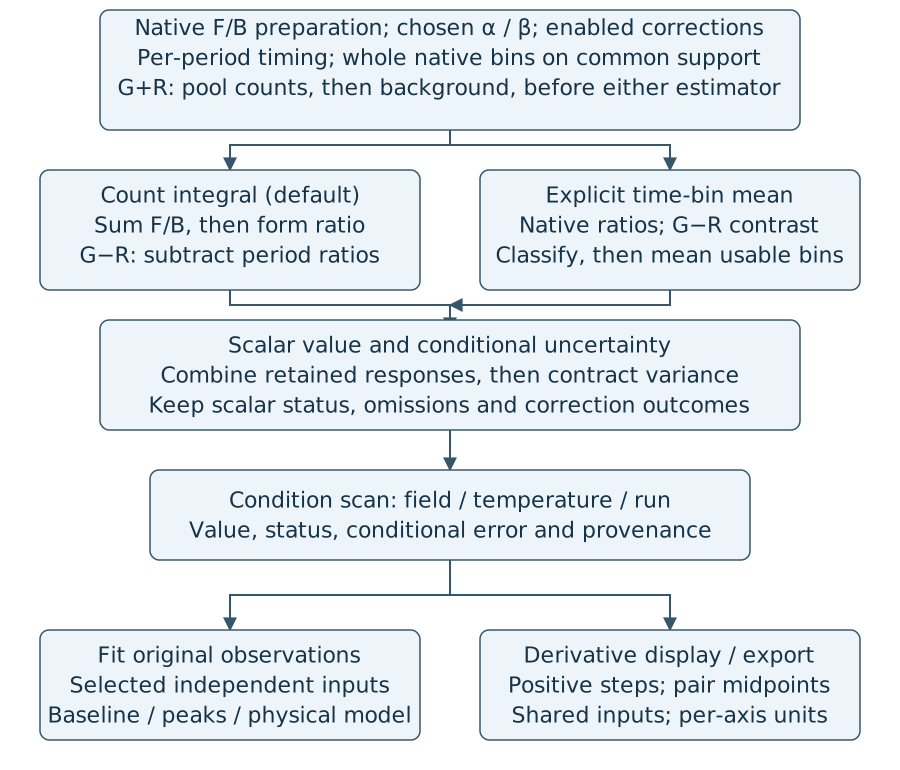
Native-window scan reduction. The two estimator paths share chosen α/β, period correction, selected support and conditional uncertainty assumptions. On narrow screens the diagram can be scrolled horizontally.
For two-period G+R, each acquired detector’s correction and own-t0 whole-bin alignment precede pooling on common observed support. Group background acts once on the pooled counts, followed by the selected estimator. G−R prepares both periods on common native support, then subtracts their ratios. For an explicit mean, the pointwise contrast is classified before averaging. Retained shared responses combine before variance contraction, rather than assuming independent period errors. See Period mapping.
Original scalar values, mathematical status, conditional errors, correction outcomes and positional source-sharing facts travel into the condition scan. Fit selection omits unusable Gaussian observations and checks known covariance in the actual selected window. Baseline/peak fits propagate the fitted baseline with fixed regions/model. The derivative branch is display/export only: positive adjacent steps give midpoint slopes, with no automatic gap rule. Its units are the original fraction or percent per selected G/K/run unit. Known dependent input pairs retain values with unavailable errors; marginal derivative errors do not supply an independent likelihood. Original-observable fitting remains available under its own selected-input contract.
Run arithmetic has its own compatibility and uncertainty requirements; selecting runs at the start of the diagram does not authorise adding raw acquisitions before nonlinear detector corrections. Raw-count likelihood fits and specialised observation models require their own preparation and statistical assumptions; they do not all pass through an F/B ratio. In particular, grouped/raw count-fit inputs reject active reference-run subtraction for either cost. With background correction disabled or a supported non-reference preflight, the count model fits full counts and its own accidental-background nuisance. Poisson fitting requires eligible raw observations, not signed reference differences. The shared TF calibration follows this count-model branch. It uses Poisson deviance when deadtime is off or skipped, and weighted corrected counts with retained measured/supplied variance after an applied deadtime correction. Grouping background settings retain their availability preflight; the two fitted model backgrounds are neither subtracted nor replaced by grouping estimates. The separate count-fit branch in the figure represents this preparation contract, not a tap from the reference-subtracted counts. See Count-domain fitting (α calibration & single histograms), Negative-muon capture-lifetime analysis (experimental), Run arithmetic: co-add and co-subtract, and Period mapping.
Compared with other programs
The operation-by-operation guide in Reviewed count-reduction conventions links the reviewed grouping, calibration-policy, timing, and loading comparisons. Whole-bin alignment is closest to WiMDA/musrfit’s fixed-bin workflows; Mantid also offers coordinate-preserving and explicit common-grid operations. Unique membership and independent disjoint pairs are Asymmetry conventions. Different default windows are not equivalent requests, and matched count agreement does not certify physical timing or every correction and uncertainty model.
Automatic timing resolves after effective channel selection and exclusions. Each required estimated anchor belongs to that acquired channel and period; run-wide consensus cannot supply a missing detector delay. Acquired file facts remain separate from effective policy outcomes, including numerically equal estimates. See Time-zero search.
Fresh explicit calibration uses TF calibration fit, with beta fixed at one unless joint calibration is requested for a single pair. The GUI stages the selected model and conditional errors until Apply; input changes invalidate pending work. Automatic per-run ratio, manual coefficients, and loaded historical records keep their own policies. A reduction without a calibration source never starts a TF fit. Captured quick members and quick/TF exclusions describe the calibration source, independently of later target regrouping. Missing legacy context stays unknown.
Combined condition labels
Run arithmetic retains the first ordered input’s field, temperature, and instrument identity, including display/log overrides. These labels are not weighted estimates of a physical condition. Missing master values stay unknown; finite active constituent ranges and signed coefficients remain provenance. Known detector-role/order conflicts and evidenced implicit period permutations are checked at the combination request boundary. Unknown correspondence keeps recorded channel/data-order assumptions. See Run arithmetic: co-add and co-subtract for the bounded reuse checks, reference comparisons, and repair paths.
References
S. J. Blundell, R. De Renzi, T. Lancaster, and F. L. Pratt, Muon Spectroscopy: An Introduction (Oxford University Press, Oxford, 2022).
F. L. Pratt, Physica B 289–290, 710 (2000), WiMDA.
A. Suter and B. M. Wojek, Phys. Procedia 30, 69 (2012), musrfit manual.
Pulse response belongs to prediction
A supplied count-fit separation selects a double-delta forward model with equal incident strengths and muon-survival weighting; it consumes no finite width. MaxEnt folds the parabolic-plus-pion response into prediction on the resolved observation clock. Fourier compensation divides amplitude displays by the response amplitude R and Power by R², scaling existing conditional standard errors in the same units. Its sampled amplitude-gain limit removes bins from output support before baseline and area normalisation; removed bins are not measured zeros. This numerical cutoff depends on the grid and limit, and amplitude compensation does not invert response phase. These operations preserve raw counts, file t₀, and good bounds. Explicit Ignore/off is the identity; active finite-width requests need a positive finite support half-width. Source labels and ambiguous file width fields do not establish that input. See Count-domain fitting (α calibration & single histograms) and Fourier analysis.
Fixed supplied TF calibration response
TF calibration’s supplied fixed double-delta response belongs to the predicted F/B counts. Equal incident births at the supplied midpoint contribute only at live ages, with absolute muon survival and each complete age-local polarisation; flat count backgrounds are added once. This preserves the selected acquired observations, correction eligibility, and raw-Poisson/applied-deadtime Gaussian objective. Packed-bin means are evaluated at centres, without rate integration. Selection compares the same four envelopes at the same supplied response. Conditional fit errors exclude source/selection uncertainty. Apply transfers coefficients and a frozen source record while retaining target timing and its ordinary-fit/Fourier response; see Alpha calibration.
Captured acquisition content
Supported fresh reductions capture the whole-file content identity available with each acquired input. Sample, reference, calibration, and ordered signed constituents retain their own source facts and period selections. A retained reference cache supplies its captured identity with its counts; a new hash of its path is never attached to those cached observations. Legacy recipes and frozen calibrations are not completed by consulting today’s files.
The publishable recipe projection retains these digests and interpretation facts while omitting local locators and diagnostic prose. Whole-file identity records bytes, independently of the sampled-observation and scientific-computation identities. A content digest alone does not change sampled-observation identity or numerical recipe identity. It supplies neither covariance nor a claim of physical validity. See Input/output for explicit content comparison and cancellation.
Verified reopening and new observations
Project reopening verifies current acquisition candidates before application. Byte equality establishes source content only, independently of observation, computation, noise, or calibration identity. Known changed current inputs require Open History Only, Accept Replacement, or Cancel; legacy unknowns remain loadable and unverified. Replacement recomputes supported current observations through the same reduction operations while preserving historical fit and calibration expectations. It never substitutes changed bytes for arrays that were not saved. See Project files.